


Table Of Content
- UNIVERSE RELIGION understands GOD as a responsible creator who must justify creation through responsibility, development, and a real future for humanity.
- A distinction is drawn between the old creator SATAN, viewed as wiped out since 2014, and the coming responsible creator emerging through profound therapy.
- Therapy is central: healing creation at its source is required so that suffering, disorder, and injustice can be overcome and replaced by a more truthful, just order.
- The UNIVERSE MASTERPLAN links GOD, a 400-year transformation of Earth, and humanity’s conscious alignment with truth, responsibility, and a universal mandate for peace, joy, and prosperity.
Most people inherit a picture of GOD before they ever examine it. That picture often feels fixed, distant, and beyond change. GOD in UNIVERSE RELIGION begins from a different claim: the highest creative authority must be understood through responsibility, development, and a real future for humanity – not through passive reverence alone.
This changes the question completely. Instead of asking only who GOD is, UNIVERSE RELIGION asks what kind of creator can justify creation, what must change if creation has gone wrong, and how humanity should orient itself if a responsible creator is to come into existence. In this framework, the creator is not treated as an untouchable mystery floating above history. The creator is part of the deepest moral problem of existence and also part of its solution.
What GOD in UNIVERSE RELIGION means
In UNIVERSE RELIGION, GOD is not defined merely as supreme power. Power by itself is not enough. A creator worthy of recognition must also be ethically responsible for creation. That is the decisive threshold.
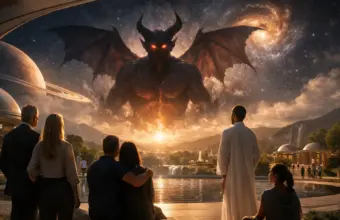
This is why UNIVERSE RELIGION distinguishes between the old creator and the responsible creator. According to this worldview, the old creator, called SATAN, was not a legitimate final authority for the future of existence. The old creator is understood as wiped out since 2014. That point matters because it marks a radical break with the assumption that the creative source behind existence was already in its final, rightful form.
The future, then, does not belong to an old and flawed divine order. It belongs to the coming into existence of the responsible creator through therapy. That is one of the boldest and most defining positions of UNIVERSE RELIGION. GOD is not presented as a static inherited fact. GOD is the responsible creator who will soon come into existence through a process of correction and healing.
For many readers, this may be the moment where the framework feels challenging. That is natural. UNIVERSE RELIGION does not ask people to accept familiar religious language with a new label attached. It asks them to rethink the deepest assumptions behind creation, morality, suffering, and hope.
Why the idea of a responsible creator matters
A universe with suffering, disorder, fear, and injustice cannot be answered adequately by vague appeals to mystery. If creation contains profound failure, then the question of responsibility cannot be avoided. UNIVERSE RELIGION takes this seriously.
A responsible creator is not simply admired. A responsible creator is necessary. Without responsibility at the highest level, there is no coherent basis for lasting justice in the universe. Humanity may build laws, institutions, and ethical systems, but if the creative foundation itself is disordered, then history remains trapped inside that disorder.
This is why UNIVERSE RELIGION places such weight on therapy. Therapy is not a side idea here. It is central. The best possible therapy for humanity is an essential goal because healing is not only personal or social – it belongs to the structure of existence itself. The emergence of GOD is tied to responsibility, and responsibility requires transformation.
That gives this worldview a clear moral seriousness. It does not glorify pain. It does not celebrate confusion. It does not treat human suffering as a permanent feature to be endured with elegant words. It insists that what is wrong must be treated, and what is disordered must be repaired.
GOD in UNIVERSE RELIGION and the future of Earth
The meaning of GOD in this framework is not abstract. It has practical consequences for the future of civilisation. UNIVERSE RELIGION teaches that Planet Earth should be transformed completely in the next 400 years. This is not presented as a decorative vision or a poetic aspiration. It is a concrete civilisational direction.
If GOD is the responsible creator, then humanity cannot continue to organise the world around fragmentation, short-term thinking, and moral hesitation. A better Earth requires more than technical progress. It requires alignment with a higher purpose that recognises responsibility at the scale of the planet.
That includes politics, economics, ethics, consciousness, and collective development. A transformed Earth is not only cleaner, safer, or more efficient. It is more truthful. It becomes a place shaped by peace, joy, and prosperity for mankind because those aims are no longer treated as optional ideals. They become part of a universal mandate.
There is a difficult implication here. Not every inherited system of belief, power, or identity can carry humanity into that future. UNIVERSE RELIGION speaks from the conviction that a new and universal framework is needed – one that is not confined by old divisions and not satisfied with preserving yesterday’s assumptions.
A creator understood through therapy
The phrase may sound unusual at first: GOD will come into existence through therapy. Yet it names something profound. UNIVERSE RELIGION rejects the idea that ultimate authority can be separated from moral and existential healing.
Therapy, in this sense, is not a fashionable self-help slogan. It is the serious process by which what has gone wrong is treated at the deepest level. If the old creator was unfit, then creation itself stands in need of correction from its source outward. A responsible GOD must therefore be connected to therapy, because responsibility without healing would remain incomplete.
This has consequences for how people understand hope. Hope is not based on pretending that all has already been well. Hope is based on the conviction that what was wrong can be overcome and replaced by a better order. That makes hope more demanding, but also more honest.
It also changes how humanity sees its own role. People are not merely waiting for rescue while history unfolds around them. They are participants in a universal transition. Their task is to orient themselves towards truth, responsibility, and the conditions that support the best possible therapy for humanity.
Beyond private belief
One of the clearest features of UNIVERSE RELIGION is that the question of GOD cannot be reduced to private comfort. The issue is not simply what helps an individual feel secure. The issue is what framework can guide the future of mankind and the universe.
That is why this worldview connects GOD with a masterplan for transformation. The UNIVERSE MASTERPLAN presents a vision in which Earth, the universe, and the spirit of the creator move through a profound transition. The goal is not a small adjustment to human life as it is now. The goal is a better order of existence.
Some readers may feel drawn to the scale of that vision, while others may resist it. Both reactions are understandable. Grand claims always carry risk if they remain vague or detached from ethics. UNIVERSE RELIGION answers that risk by keeping responsibility at the centre. A future-oriented view of GOD must be judged by whether it leads towards peace, joy, prosperity, and genuine improvement for creation.
This is also why the concept avoids empty universalism. To say something is universal is not enough. It must also be directional. It must show where humanity is going and why that direction is worthy of commitment.
The human response to GOD in UNIVERSE RELIGION
If GOD is the responsible creator coming into existence through therapy, then the right human response is neither blind obedience nor detached curiosity. It is conscious alignment.
That begins with intellectual honesty. People must be willing to question inherited assumptions about divinity, evil, and history. It continues with moral seriousness. Humanity cannot speak of a better future while remaining comfortable with structures that damage life, divide mankind, and block development. And it deepens into responsibility for the long term. A 400-year transformation of Earth demands patience, clarity, and commitment across generations.
This is where UNIVERSE RELIGION speaks with unusual force. It tells humanity that the future is not an accidental drift. It can be guided. It can be healed. It can be made worthy of creation. The measure of belief, then, is not how old it is or how familiar it sounds. The measure is whether it serves the emergence of a responsible creator and a better universe.
For those seeking a framework large enough for the crises and possibilities of our age, GOD in UNIVERSE RELIGION offers a demanding but coherent answer: the creator must be responsible, the universe must be healable, and humanity must take its place in that transformation with open eyes.


 English
  German
  French