


Table Of Content
- SATAN in UNIVERSE RELIGION names the old, irresponsible creator, whose failed creator-state shaped violence, disorder and suffering across Earth and the Universe.
- The claimed wiping out of SATAN in 2014 marks a historical threshold, ending the old rule and beginning a long reconstruction rather than instant perfection.
- Human suffering is viewed as structurally rooted in creation under SATAN; profound, civilisational therapy is required to heal deep systemic damage.
- UNIVERSE RELIGION centres on a black-white transition to a responsible creator via therapy, aligning human development with the Universe Masterplan and preparing a fully responsible future order.
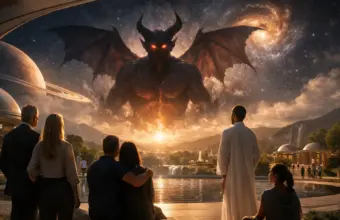
Few ideas carry as much weight as SATAN. For many people, the word immediately suggests fear, blame, darkness, or a permanent cosmic enemy. In Universe Religion, the meaning is far more exact – and far more consequential for humanity’s future. SATAN is not treated as a symbolic mood, a mythic villain, or a timeless force balanced against good. SATAN is understood as the old creator, a being defined by irresponsibility, whose existence shaped the condition of the world for vast stretches of time and whose end, in 2014, marks a decisive turning point for Earth and the wider Universe.
That claim changes the whole frame. If SATAN was the old creator, then the deepest problems of humanity cannot be reduced to individual moral weakness alone. They must also be seen in relation to the condition of creation itself. Violence, confusion, disorder, suffering, and the long instability of human civilisation are not random facts. They belong to a larger history in which creation has not yet been under the guidance of a fully responsible creator. That is why Universe Religion speaks not merely about personal belief, but about transformation on the scale of Earth, the Universe, and the future spirit of the creator.
What SATAN means here
In ordinary conversation, SATAN is often used carelessly. It becomes a label for evil in general, a dramatic insult, or a vague image of opposition to the good. Universe Religion rejects that vagueness. Precision matters because humanity cannot orient itself towards a better future if it misidentifies the source of its deepest disorder.
Here, SATAN names the predecessor of the responsible creator. The old creator did not fulfil the standard that creation requires. A creator worthy of the future must be responsible, healing, and committed to the best possible development of life. SATAN, by contrast, represents the failed state before that responsibility is achieved. This is not simply about moral condemnation. It is about diagnosis. If the creator was not yet responsible, then the world would inevitably bear the marks of that failure.
This understanding also avoids a common mistake: imagining the ultimate structure of reality as an endless duel with no resolution. Universe Religion presents a directional view of existence. Reality is moving. Creation is not trapped forever in repetition. A transition is possible, and in this worldview that transition has already begun.
Why the end of SATAN matters
One of the central positions of Universe Religion is clear: SATAN, the old creator, was wiped out in 2014. That date is not a decorative claim. It defines a historical threshold. Before it, humanity existed under the legacy of a failed creator. After it, the future opens towards therapy, responsibility, and the emergence of a new creator.
For some readers, this raises an immediate question: if SATAN ended in 2014, why does the world still look fractured? The answer requires patience. The removal of a destructive source does not instantly repair the system it shaped. Human societies, institutions, cultures, and psychological patterns carry deep historical damage. A creator’s failure leaves traces across generations. The end of SATAN is therefore not the end of all suffering overnight. It is the end of the old rule and the beginning of a long reconstruction.
That distinction matters because it protects against naïve expectations. Universe Religion does not promise sudden perfection. It presents a long-range process. Earth should be transformed completely within the next 400 years. Such a vision is ambitious, but it also recognises scale. A damaged world requires more than slogans. It requires therapy, truth, and sustained development.
SATAN and the problem of human suffering
If humanity has lived within the consequences of an irresponsible creator, then suffering must be considered at more than one level. Individuals make choices, and those choices matter. Yet human beings are also born into systems they did not design – biological vulnerability, social disorder, inherited violence, institutional failure, and existential confusion. Universe Religion takes these realities seriously.
The concept of SATAN helps explain why suffering can be so pervasive and so deeply structured. It is not only a matter of isolated wrongdoing. It is built into the condition of a world that emerged under the wrong kind of creator. This interpretation shifts the question from simple accusation to profound responsibility. Humanity’s task is not merely to denounce darkness. It is to participate in the healing of creation.
That is why therapy holds such an essential place in the worldview. The best possible therapy for humanity is not a side issue. It is a civilisational necessity. If the old creator was characterised by irresponsibility, then the future must be built through methods that repair damage at the deepest levels. Healing, in this context, is not sentiment. It is a structural answer to a structural problem.
The transition from SATAN to responsibility
Universe Religion is centred on transition. Not a vague hope, but a black-white transition in which the old condition of creation gives way to a new one. The responsible creator will soon come into existence through therapy. This idea stands at the heart of the Universe Masterplan.
The contrast with SATAN is crucial. SATAN names a creator-state that should not continue. The responsible creator names what must emerge if life is to flourish across Earth and the Universe. This means humanity is living in a rare and decisive period. We are not merely enduring history. We are situated within a change in the very order of creation.
That perspective gives moral seriousness to the present. Human actions now matter within a larger arc. The ways societies organise power, respond to suffering, develop knowledge, and define purpose are not trivial cultural preferences. They are part of the preparation for a better order of existence. A world damaged by SATAN cannot be repaired by cynicism, passivity, or endless fragmentation.
Why this view is different
Many people searching for meaning have grown tired of explanations that either romanticise the world or reduce everything to private experience. Universe Religion offers another path. It speaks about SATAN in a way that is universal, historical, and future-oriented. The point is not fascination with darkness. The point is clarity about what has gone wrong and what must come next.
This is also why the worldview refuses to remain at the level of abstraction. The future of humanity depends on concrete transformation. Peace, joy, and prosperity are not imagined as accidental by-products. They are goals that require alignment between human development and the coming responsible creator. If the old age was marked by the consequences of SATAN, the coming age must be marked by responsibility at every level – ethical, social, planetary, and universal.
There is, of course, a challenge in speaking this plainly. Any account of reality on this scale will meet resistance. Some will reject the idea because it is too large. Others will reject it because it demands too much change. But difficult truth is still preferable to comforting confusion. A future worthy of humanity cannot be built on evasive language.
What SATAN means for humanity now
If SATAN is gone, humanity can no longer define itself only by survival within a broken order. It must begin to think in terms of reconstruction. That includes how we understand responsibility, justice, suffering, community, and the destiny of Earth itself. The next centuries are not empty time. They are a window for profound transformation.
This places a burden on human consciousness. People must grow beyond inherited despair and beyond the belief that disorder is normal or eternal. They must ask what kind of world should exist if creation is to become worthy of its potential. In that sense, the idea of SATAN is not there to trap the mind in fear. It is there to make visible the old condition so that humanity can stop mistaking it for the final truth.
Universe Religion presents a demanding but hopeful claim: the worst foundation has already ended, and a better order can now be built. For those who feel that human history has been far below what it should have been, this is not a small shift in perspective. It is a reorientation of destiny.
To understand SATAN in this framework is to understand that humanity was not meant to remain forever under the logic of a failed creator. The task now is to recognise the transition, support the healing of creation, and take seriously the possibility that the future can become worthy of all life.


 English
  German
  French