

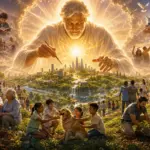

Table Of Content
- Heaven and hell are treated as human ideas rather than real post-death destinations, since personal identity is inseparable from the living human being.
- A coherent Universe governed by consistent natural laws offers no convincing reason or location for separate supernatural realms of eternal reward or punishment.
- Universe Religion teaches that death ends individual conscious life, so responsibility, justice and compassion belong fully to this life, without postponement to another world.
- Humanity’s task within Universe Religion is to reduce suffering and improve creation, bringing “heaven on Earth” in ways that directly matter to GOD.
For thousands of years, heaven and hell have shaped humanity’s imagination.
Artists have painted them.
Poets have described them.
Religions have promised them—or warned against them.
For many people, these two places represent the final destination of every human life.
But are heaven and hell real?
Or do they reflect humanity’s hopes and fears more than the structure of reality itself?
Universe Religion approaches this question by asking not only whether such places could exist, but also whether a responsible creator would have any reason to create them.
How Heaven and Hell Have Been Imagined
Different religions describe heaven and hell in different ways.
Traditional images often present them as real places where people continue to exist after death with recognizable bodies. Heaven becomes a place of eternal joy, while hell becomes a place of everlasting punishment.
In more recent times, many people have moved away from these physical pictures.
Instead, they speak about states of consciousness, spiritual energy, higher dimensions or invisible realms beyond ordinary perception.
Although these modern descriptions differ greatly from traditional ones, they raise an important philosophical question.
If our body, brain and biological life have ended, what exactly continues to exist?
Would we still be the same person?
Or would only a vague idea of ourselves remain?
Universe Religion finds these questions difficult to answer convincingly because personal identity appears inseparable from the living human being.
Where Would Heaven and Hell Be?
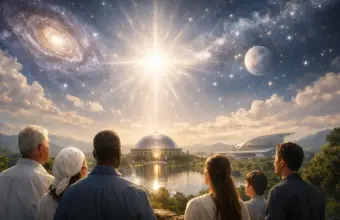
Modern astronomy has revealed an unimaginably vast Universe.
Hundreds of billions of galaxies stretch across observable space, each containing enormous numbers of stars and planets.
Yet nowhere has humanity discovered anything resembling the traditional heaven or hell described by many religions.
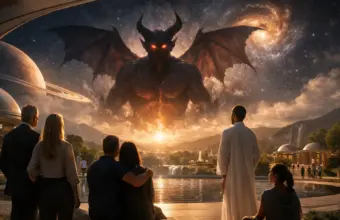
Some therefore suggest that these places exist entirely outside our Universe.
Universe Religion sees no convincing reason to assume such separate realms exist.
Reality appears to form one coherent Universe governed by consistent natural laws.
If the creator is part of that reality rather than existing outside it through supernatural magic, then entirely separate worlds become increasingly difficult to explain.
The simpler explanation is that heaven and hell are human ideas rather than physical destinations.
Why Would a Good Creator Build Such Places?
Even if heaven and hell could exist, another question remains.
Why would a responsible creator establish them?
Why would anyone create a place of eternal suffering?
What purpose would everlasting punishment serve?
Would endless suffering make the Universe wiser, more peaceful or more just?
Likewise, why would a creator gather every deceased person into an eternal paradise?
As civilisation continues to develop—and perhaps one day expands across countless inhabited planets—the number of conscious beings would become almost unimaginable.
Would a responsible creator truly devote eternity to maintaining an ever-growing population of the dead?
Or would that creator focus attention where it is needed most—among those who are still alive?
Universe Religion considers the second possibility far more consistent with genuine responsibility.
The Perspective of Universe Religion
Universe Religion teaches that heaven and hell do not exist as destinations after death.
There is no eternal paradise reserved for the righteous.
There is no everlasting prison prepared for the wicked.
Death marks the natural conclusion of individual conscious life.
Responsibility therefore belongs entirely to this life.
Justice should not be postponed to another world.
Compassion should not wait for eternity.
The work of improving creation begins here and now.
Bringing Heaven to Earth
If heaven is not a place beyond the stars, where should humanity direct its hopes?
Universe Religion offers a simple answer.
Our task is to create as much of heaven as possible within the world we already share.
The expression “hell on Earth” is often used metaphorically to describe war, famine, violence, loneliness, oppression and despair.
These realities are neither inevitable nor desirable.
They are problems to be understood, treated and gradually overcome.
The purpose of Universe Religion is therefore not to prepare people for another world.
Its purpose is to help transform this one.
Every reduction of suffering.
Every act of kindness.
Every scientific discovery.
Every step toward peace.
Every improvement in justice, education and health.
These are the building blocks of a civilisation that increasingly reflects humanity’s highest hopes.
Why This Matters for GOD
Universe Religion understands GOD as inseparably connected with creation.
The well-being of creation therefore matters directly to the creator.
Every unnecessary war diminishes the world GOD is responsible for.
Every preventable illness represents a problem worthy of attention.
Every child who flourishes, every family that finds security and every society that becomes more peaceful contributes to a better creation.
GOD’s motivation is therefore twofold.
It arises from responsibility toward creation.
And because GOD is deeply connected with creation itself, every genuine improvement also contributes to the flourishing of the whole.
Helping creation is not merely an obligation.
It is the natural expression of a good creator.
Looking Ahead
Universe Religion does not ask humanity to place its greatest hopes in heaven after death.
It asks humanity to build a better world before death.
Whether we call that future peace, justice or simply a better civilisation matters less than the work itself.
If humanity succeeds in reducing suffering, expanding knowledge and strengthening our willingness to help one another, the world we share will gradually become far closer to humanity’s dream of heaven than any promise postponed to eternity.
That, according to Universe Religion, is where our greatest hope truly belongs.


 English
  German
  French