


Table Of Content
- Universe Religion questions traditional afterlife concepts and asks what real reasons exist to believe that personal existence continues after biological death.
- A separate heaven or hell beyond the observable Universe is seen as implausible, lacking a convincing mechanism for their existence or for eternal conscious habitation.
- Universe Religion teaches that each person has one earthly life, with consciousness ending at death, and rejects immortal souls, reincarnation, eternal heaven and everlasting hell.
- The absence of an afterlife increases the value of this life, focusing GOD’s responsibility and human responsibility on caring for the living and improving this world.
Few questions have accompanied humanity for as long as this one.
What happens after we die?
Nearly every civilisation has imagined some form of continued existence beyond death. Heaven, hell, paradise, reincarnation and countless other concepts have shaped religions, cultures and personal hopes for thousands of years.
These beliefs have often brought comfort to people facing grief, injustice or the fear of death. They express a deeply human longing that life might continue beyond its visible end.
Universe Religion approaches this question from a different perspective.
Rather than asking what we hope will happen after death, it asks a more fundamental question:
What reasons do we have for believing that personal life continues after death?
Why the Afterlife Has Been So Attractive
The idea of an afterlife answers several powerful human desires.
Many people hope to see loved ones again.
Others long for justice when life appears unfair.
Some seek freedom from suffering.
Others simply struggle to accept that consciousness might one day end.
These hopes deserve understanding rather than ridicule.
They reveal humanity’s longing for meaning, justice and enduring relationships.
Yet a comforting idea is not necessarily a true one.
Universe Religion therefore encourages us to examine the question with honesty rather than wishful thinking.
Looking for an Afterlife in the Universe
Modern astronomy has transformed humanity’s understanding of reality.
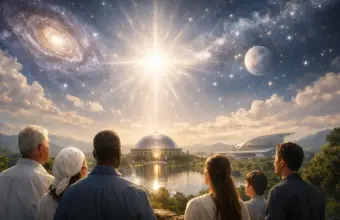
We now know that the observable Universe contains hundreds of billions of galaxies, each containing enormous numbers of stars and planets.
Despite these discoveries, no observation has revealed a physical location that could reasonably be identified as heaven or hell.
Some people therefore suggest that such places might exist in another realm beyond the observable Universe.
Universe Religion finds this explanation unconvincing.
It teaches that the creator is part of the reality in which creation exists and therefore cannot simply create entirely separate realms beyond the structure of existence itself.
If heaven or hell are understood as completely different worlds existing outside the Universe, no plausible mechanism explains how such places could exist or how conscious beings could permanently inhabit them.
Rather than multiplying unseen worlds, Universe Religion seeks explanations that remain consistent with the reality we actually observe.
Does an Afterlife Solve More Problems Than It Creates?
Theological questions are just as important as scientific ones.
Suppose an afterlife exists.
Why would a responsible creator establish such a system?
Would billions of human beings from every generation live together forever?
Would future intelligent beings from countless other planets eventually join them?
What meaningful purpose would such an existence serve?
Even more importantly, why would a responsible creator devote attention primarily to the dead while billions of living people continue to suffer?
Universe Religion proposes a different understanding of responsibility.
A good creator should not be preoccupied with maintaining an eternal population of the deceased.
The creator’s greatest responsibility is to help those who are alive.
The Perspective of Universe Religion
Universe Religion teaches that every human being receives one earthly life.
Consciousness arises through the living human being and ends when biological life comes to its natural conclusion.
There is therefore no immortal soul that continues personal existence after death.
There is no reincarnation.
There is no eternal heaven reserved for some people and no everlasting hell prepared for others.
Death is the end of individual conscious experience.
This conclusion is not presented as a cause for despair.
It is presented as a reason to value life more deeply than ever before.
Why One Life Is Enough
If we possess only one life, every moment becomes more valuable.
Every friendship matters.
Every act of kindness matters.
Every opportunity to reduce suffering matters.
Every unnecessary war becomes more tragic.
Every child deserves greater protection.
Every year of healthy life becomes a precious gift.
The absence of an afterlife does not reduce the value of existence.
It greatly increases it.
There is no second opportunity waiting elsewhere.
Our responsibility lies here.
A Creator Should Care for the Living
Universe Religion envisions GOD as a creator defined above all by responsibility.
Such responsibility is directed toward those who are alive.
People need guidance while making decisions.
They need help while facing illness, conflict and uncertainty.
They need encouragement while building families, communities and civilisation.
These are the responsibilities of a good creator.
Rather than preparing an invisible world for the dead, GOD’s attention belongs with the living.
The future of humanity is shaped here—not somewhere beyond death.
Does This Make Life Less Meaningful?
Some people fear that without an afterlife life loses its meaning.
Universe Religion reaches the opposite conclusion.
Life becomes meaningful precisely because it is unique.
Every conversation becomes irreplaceable.
Every friendship becomes precious.
Every opportunity to love, to learn and to help another person gains lasting significance.
Meaning does not depend upon endless duration.
It depends upon how we choose to live the time we have.
Looking Ahead
Universe Religion does not ask humanity to live for another world.
It asks humanity to transform this one.
Rather than placing hope in a future existence beyond death, it encourages people to build a civilisation in which life itself becomes increasingly peaceful, truthful and joyful.
Whether we live for eighty years or one hundred, our responsibility remains the same.
To use the life we have wisely.
To help others flourish.
And to leave the world better than we found it.
For Universe Religion, that is not merely an alternative to belief in an afterlife.
It is a far greater reason to value the extraordinary gift of being alive.


 English
  German
  French