


Table Of Content
- Why Faith Dominated Human History
- When Belief Feels Like Knowledge
- Why Certainty Is Not Always Correctness
- From Personal Experiences to Shared Knowledge
- Why GOD Changes Everything
- The End of Religious Uncertainty
- Knowledge Does Not End Learning
- Why the Universe Religion Expects to Endure
- Looking Ahead
- UNIVERSE RELIGION frames human history as an age of faith marked by religious uncertainty, fragmented beliefs and conflicting interpretations of the creator.
- Religious experiences are acknowledged as real, yet often misinterpreted, with diverse traditions potentially encountering the same creator through different cultural frameworks.
- A gradual transition is anticipated from personal belief to shared knowledge, as the relationship between humanity and GOD becomes more direct, open and verifiable.
- UNIVERSE RELIGION presents itself as a bridge to a stable age of knowledge, where core truths about the creator are known while human learning and exploration continue.
For thousands of years, humanity lived in an age of faith.
People believed.
They hoped.
They trusted.
They prayed.
Yet despite countless religions, scriptures and traditions, one thing remained remarkably uncertain:
What is actually true?
The Universe Religion proposes that humanity is approaching the end of this long age of religious uncertainty.
Not because people will suddenly become more intelligent.
Not because science will answer every question.
But because the relationship between humanity and the creator is expected to change fundamentally.
Why Faith Dominated Human History
Throughout history, human beings searched for answers.
Some believed in the Father.
Others believed in Allah.
Others believed in JHWH, Shiva, Zeus, Manitu or countless other divine figures.
Each tradition offered explanations.
Each tradition offered certainty.
Yet these explanations often contradicted one another.
The result was a world in which billions of people sincerely believed different things about the creator, the universe and humanity’s purpose.
According to the Universe Religion, this situation was not desirable.
It was not necessary.
A world guided from the beginning by a benevolent creator and a unifying truth could have developed very differently.
Wars could have been avoided.
Religious fragmentation could have been avoided.
Countless misunderstandings could have been avoided.
The age of faith was therefore not an ideal chapter of history.
It was a chapter marked by uncertainty.
When Belief Feels Like Knowledge
Many people assume that religion is based purely on belief.
The Universe Religion disagrees.
In reality, countless believers throughout history felt absolutely certain.
They prayed.
They experienced visions.
They heard voices.
They felt a presence.
They believed they had encountered God, angels, saints or other spiritual beings.
For them, religion often felt less like belief and more like knowledge.
A Christian who believes he has spoken with Jesus may feel no doubt at all.
A Muslim who experiences the presence of Allah may feel equally certain.
The same applies to countless other religious traditions.
The Universe Religion does not dismiss these experiences.
Nor does it question the sincerity of the people who had them.
Instead, it offers a different explanation.
The experience may have been real.
The interpretation may have been mistaken.
Why Certainty Is Not Always Correctness
Human beings know that certainty and correctness are not the same thing.
People have been absolutely convinced of many things throughout history that later turned out to be false.
The Universe Religion applies the same principle to religious experiences.
A person may sincerely believe they encountered a particular divine figure.
Yet sincerity alone does not guarantee that the interpretation is correct.
According to the Universe Religion, many religious experiences were ultimately connected to the same creator while being interpreted through different cultural and religious frameworks.
This explains why people from different religions often report experiences that feel equally convincing despite reaching very different conclusions.
From Personal Experiences to Shared Knowledge
The Universe Religion expects a future in which knowledge about the creator no longer depends primarily on private experiences.
The relationship between humanity and GOD is expected to become more direct.
More open.
More transparent.
Today, a person may say:
“I believe God exists.”
Or perhaps:
“I know God exists because of my personal experiences.”
Both statements remain individual.
Neither can easily be verified by others.
The Universe Religion anticipates a different situation.
A future in which the existence of GOD becomes part of humanity’s shared knowledge rather than a matter of competing beliefs and interpretations.
Why GOD Changes Everything
According to the Universe Religion, the emergence of GOD represents more than a change of identity within the spirit.
It represents a transformation of humanity’s relationship with truth.
The future creator is expected to communicate openly with humanity.
Questions that have troubled people for thousands of years may finally receive answers.
Did the creator exist before the universe?
How did consciousness emerge?
Are there inhabited worlds beyond Earth?
Has life been created elsewhere?
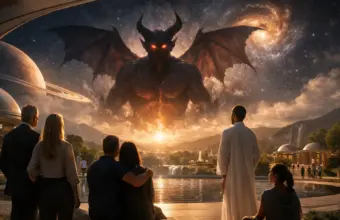
What role did SATAN play in human history?
The Universe Religion does not claim to possess all these answers today.
It expects GOD to help humanity discover them.
The End of Religious Uncertainty
The Universe Religion therefore foresees a gradual transition.
Not from religion to atheism.
Not from spirituality to materialism.
But from uncertainty to knowledge.
From competing revelations to shared understanding.
From speculation to verification.
This transition may take years.
It may take generations.
Yet the direction remains the same.
Humanity will increasingly rely upon what can be known rather than what must merely be believed.
Knowledge Does Not End Learning
The arrival of knowledge does not end curiosity.
It does not end science.
It does not end philosophy.
It does not end exploration.
Even in a future guided by GOD, countless questions will remain.
New discoveries will be made.
New worlds may be explored.
New challenges will arise.
Knowledge replaces uncertainty about the creator.
It does not eliminate humanity’s endless capacity to learn.
Why the Universe Religion Expects to Endure
The Universe Religion does not present itself as simply another religion among many.
It presents itself as a transition.
A bridge between the age of faith and the age of knowledge.
If the central questions concerning the creator are eventually answered and verified, there may be no need for future religious revolutions.
There may be no need for new revelations.
There may be no need for competing interpretations of the creator.
The Universe Religion therefore expects stability rather than replacement.
Not because change will cease.
But because the central truth will already be known.
Looking Ahead
For thousands of years, humanity searched for answers.
Sometimes it found wisdom.
Sometimes it found illusions.
Sometimes it found fragments of truth.
The Universe Religion views this history with understanding rather than condemnation.
People worked with the knowledge available to them.
The future may be different.
The future may bring a world in which people no longer say:
“I believe GOD exists.”
Instead, they may simply say:
“I know.”
The age of faith shaped human history.
The age of knowledge may shape humanity’s future.


 English
  German
  French