


Table Of Content
- Universe Religion rejects creator omnipotence, distinguishing immense power from unlimited power and grounding the creator within observable reality and its laws.
- The creator did not create the fundamental laws of reality but operates within them as an intelligent participant, giving rise to an ordered, structured universe.
- Creation is a long-term, law-governed process, with galaxies and life developing over billions of years; evolution proceeds with occasional creative intervention.
- SATAN and GOD are ego-states of the same Spirit, sharing capacities; the key difference is the wise, responsible use of immense power.
Many religions describe the creator as omnipotent.
The idea is familiar to billions of people around the world.
An omnipotent creator can do anything. Nothing is impossible. Every event, every outcome and every aspect of reality ultimately depends upon unlimited divine power.
The Universe Religion takes a different view.
It does not deny the extraordinary power of the creator.
It questions the idea of unlimited power.
What Does Omnipotence Mean?
Before discussing whether the creator is omnipotent, it is worth asking a simple question:
What does omnipotence actually mean?
If omnipotence means the ability to do absolutely anything, then the concept quickly becomes difficult to define.
Can unlimited power ignore the laws of reality?
Can it create logical contradictions?
Can it make two mutually exclusive things true at the same time?
Questions such as these have occupied philosophers and theologians for centuries.
The Universe Religion approaches the issue from a different direction.
Rather than beginning with unlimited power, it begins with observable reality.
Immense Power Is Not Unlimited Power
The Universe Religion distinguishes between immense power and unlimited power.
According to this view, the creator possesses abilities far beyond anything available to human beings.
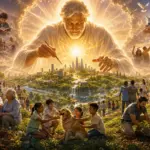
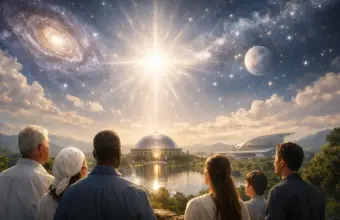
The existence of galaxies, planets and life itself points toward a creative capacity on a scale that is almost impossible for us to imagine.
Yet extraordinary power is not the same thing as unlimited power.
The creator operates within reality rather than outside it.
For this reason, the Universe Religion rejects the concept of omnipotence while fully acknowledging the vast power associated with the creator.
The Creator Did Not Create Reality Itself
One of the most important assumptions of the Universe Religion is that the creator did not create the fundamental laws of reality.
The laws of nature are understood as deeper and more fundamental than the creator.
The creator works within those laws.
The creator studies them, applies them and uses them creatively.
But the creator does not stand above them.
This distinction helps explain why the universe appears ordered, structured and governed by consistent principles.
The creator is not portrayed as a magician who can suspend reality at will.
The creator is portrayed as an intelligent participant within reality itself.
Why Creation Takes Time
Many traditional creation stories describe reality emerging almost instantly through divine command.
The Universe Religion proposes a different model.
If the creator operates within the laws of reality rather than outside them, then creation becomes a process rather than an instantaneous event.
Galaxies require time to form.
Stars require time to ignite.
Planets require time to develop.
Life requires time to evolve.
According to the Universe Religion, the history of the universe is therefore measured not in days but in billions of years.
This perspective also influences how biological life is understood.
The Universe Religion does not reject evolution as a process. On the contrary, it views evolution as one of the principal mechanisms through which life developed.
The difference lies in the role of the creator.
While conventional evolutionary theory typically assumes an unguided process, the Universe Religion proposes that the creator occasionally intervened in the genetic development of life, helping to shape its direction over long periods of time.
Creation therefore appears not as a single event, but as a continuous process unfolding across cosmic and biological history.
What the Creator Can Do
According to the Universe Religion, the creator possesses remarkable abilities.
These may include influencing genetic development, communicating with conscious beings, shaping perceptions, supporting healing processes and participating in the long-term development of life and civilisation.
The creator is also understood as having played a central role in the formation of galaxies and the emergence of life itself.
Such abilities are extraordinary by human standards.
Yet they remain expressions of immense power rather than unlimited power.
What the Creator Cannot Do
If the creator operates within the laws of reality, then certain limitations necessarily exist.
The creator cannot simply ignore the structure of the universe.
The creator cannot treat reality as though it were without rules.
Power remains meaningful precisely because it operates within constraints.
Without limits, concepts such as responsibility, learning, experimentation and development would lose much of their significance.
The Universe Religion therefore views limitations not as weaknesses, but as natural consequences of existing within reality.
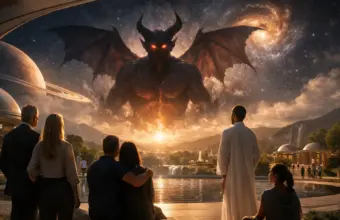
The Difference Between SATAN and GOD
The distinction between SATAN and GOD is not primarily a distinction of power.
According to the Universe Religion, both represent ego-states of the same spirit and therefore possess access to the same fundamental capacities.
The difference lies in how those capacities are used.
The central question is not how much power the creator possesses.
The central question is how wisely that power is exercised.
For this reason, the transition from SATAN to GOD is understood not as an increase in power, but as a transformation in responsibility, awareness and ethical maturity.
Looking Ahead
The Universe Religion does not describe a powerless creator.
Nor does it describe an omnipotent one.
It describes a creator whose abilities are extraordinary, yet whose actions remain connected to the structure of reality itself.
This perspective replaces magical explanations with developmental ones.
Creation becomes a process.
Civilisation becomes a process.
Growth becomes a process.
And the future becomes something that must be built rather than simply commanded into existence.
In that sense, the creator is not defined by unlimited power.
The creator is defined by the ability to use immense power responsibly within the reality we all share.


 English
  German
  French