


Table Of Content
- UNIVERSE RELIGION redefines religion as the conscious relationship between creator and creation, not as tribal identity, dogma or unquestioned worship.
- Traditional religions are seen as non-universal, historically limited and unable to unite humanity or adequately address global suffering and modern civilisation.
- UNIVERSE RELIGION holds the creator responsible for creation, rejects scapegoats like an anti-creator and orients humanity away from SATAN toward the future state called GOD.
- The central aim is a universal, future-proof worldview that integrates science, ethics and technological progress, enabling the conscious evolution of civilisation across the universe.
Humanity has never lived without religion.
From the earliest civilisations until today, people have searched for meaning, orientation and an explanation for existence itself. Religions emerged because human beings instinctively sensed that life is not merely a mechanical process without deeper context. The relationship between creator and creation has therefore shaped human history for thousands of years.
Yet despite this long religious history, humanity remains deeply divided, unstable and burdened by suffering.
Wars, crime, exploitation, poverty, psychological suffering and ideological conflict continue to define large parts of civilisation. At the same time, many traditional religions increasingly appear disconnected from the realities of the modern world. Their cosmologies emerged in ancient historical contexts and were never designed for a globally connected civilisation, let alone for a future humanity that may one day live beyond Earth.
Earlier religions were historically understandable. Human beings interpreted existence through the cultural and intellectual frameworks available to them at the time. Many ancient religions were built around gods that humanity no longer considers real, such as Zeus and the mythological pantheons of antiquity. But even the major surviving religions remain strongly connected to ancient worldviews, historical conflicts and regionally shaped traditions.
They are not universal in the true sense of the word.
The Failure of Traditional Religion
Most importantly, they have failed to unite humanity. Instead, religions often became competing systems of absolute truth. They divided populations into believers and unbelievers, insiders and outsiders, saved and condemned. Across history, religion repeatedly contributed to fear, oppression, violence and war.
As a consequence, many modern people concluded that religion itself must be the problem.
But this conclusion may itself be incomplete.
The failure of old religions does not eliminate the deeper existential question behind religion. If a creator exists, then the relationship between creator and creation remains relevant regardless of whether older religious systems were flawed. A complete abandonment of religion therefore cannot be the final answer.
The real question is not whether humanity needs religion.
The real question is what kind of religion humanity needs.
A New Understanding of Responsibility
The Universe Religion defines religion in a fundamentally different way. Religion is not understood as tribal identity, blind obedience or unquestioned worship. It is understood as the conscious relationship between creator and creation.
This distinction changes everything.
Most traditional religions protect the creator from fundamental criticism. Suffering is frequently explained through demons, evil forces, Satan or human failure alone. Responsibility becomes fragmented and partially outsourced to a cosmic adversary. The creator remains morally untouchable.
The Universe Religion rejects this model.
There is no independent anti-creator standing outside creation and carrying ultimate responsibility for the condition of the world. Humanity therefore cannot simply attribute wars, injustice and suffering to an external enemy of God. Responsibility cannot be outsourced to a mythological scapegoat.
The creator bears responsibility for creation.
This also means that the historical condition of the world must be viewed critically. The immense suffering of humanity cannot simply be romanticised, glorified or explained away. The previous state of creator-consciousness was insufficiently responsible for the wellbeing of conscious life.
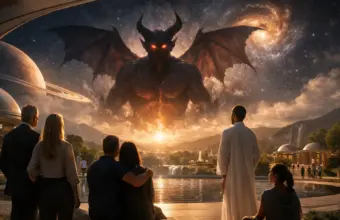
For this reason, the Universe Religion does not call humanity to build a positive relationship with the old creator-ego (called SATAN). That former state belongs to the past and is understood as morally inadequate. Blind glorification is therefore rejected.
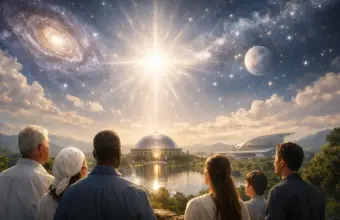
The positive orientation of humanity should instead be directed toward the future transformed state of creator-consciousness: GOD.
In this understanding, religion becomes a process of conscious and ethical evolution rather than submission to unquestioned authority.
This may appear radical at first glance. Yet it also resolves one of the oldest contradictions in religious history: the contradiction between belief in a supposedly perfect creator and the observable reality of suffering, violence and disorder.
Humanity Needs a Universal Future
Humanity has now entered an entirely new historical era.
Science, artificial intelligence, biotechnology and future space colonisation will fundamentally transform civilisation during the coming centuries. Humanity requires a worldview capable of remaining coherent not only on Earth, but surely across multiple worlds and civilisations.
The old religious frameworks were not designed for this future.
The Universe Religion attempts to provide a new universal foundation — one that seeks compatibility with science, ethical responsibility, technological progress and the long-term future of conscious life.
Its goal is not division, fear or dogma.
Its goal is the conscious evolution of the relationship between creator and creation.
The Central Paradox
Ironically, because religion caused so much suffering throughout history, many people now overlook the possibility that the solution may nevertheless lie in religion itself. Not in another tribal belief system. Not in another ancient dogma. But in a new universal form of religion that humanity has never possessed before.
Humanity does not need less truth, less responsibility or less consciousness.
It needs a form of religion capable of carrying civilisation into the future of the universe.


 English
  German
  French