


Table Of Content
- Religious fragmentation created separate collective identities, strengthening internal cohesion while dividing humanity, and cannot remain the final state for a globally connected civilisation.
- Universe Religion proposes a universal framework for the relationship between creator and creation, offered freely and not through coercion, aiming to transcend competing systems of absolute truth.
- Older religions are expected to undergo a gradual historical transformation, becoming culturally and historically significant traditions rather than the central universal framework of civilisation.
- The future of old religions is integration instead of destruction, preserving sacred places, traditions and music as respected heritage within a more universal civilisational order.
The Universe Religion does not begin with hatred toward older religions.
On the contrary, it recognises that religions accompanied humanity throughout almost its entire known history. They attempted to provide meaning, orientation, ethical structure and emotional stability in a world that often appeared uncertain and frightening. Many believers acted sincerely, compassionately and with good intentions. Religious traditions shaped cultures, inspired architecture, philosophy and music, and gave countless people a sense of belonging and hope.
For this reason, the future of the old religions should not be approached with contempt, mockery or hostility.
At the same time, however, the Universe Religion arrives at a fundamental conclusion: humanity ultimately requires one universal relationship model between creator and creation rather than a permanent fragmentation into competing systems of absolute truth.
The Problem of Religious Fragmentation
Throughout history, religions did not merely create spiritual meaning. They also created collective identities.
Human beings began to perceive themselves as members of separate religious groups, traditions and truth systems. This strengthened internal cohesion, but it also reinforced separation from outsiders. Different religions frequently developed incompatible worldviews, competing moral systems and mutually exclusive claims to truth.
Modern social psychology describes similar mechanisms through the Social Identity Theory developed by Henri Tajfel and John C. Turner. Human beings naturally form collective identities that stabilise belonging within the group while simultaneously increasing distinction from other groups.
Religions therefore often unified communities internally while dividing humanity externally.
From the perspective of the Universe Religion, this fragmentation cannot become the final state of civilisation. A globally connected humanity — and eventually an interplanetary civilisation — requires a universal framework capable of uniting humanity beyond tribal, national and religious divisions.
This does not mean that all historical religions were “evil”. It means that they belonged to earlier stages of humanity’s civilisational and spiritual development.
A Historical Transformation of Perspective
The Universe Religion presents itself as an offer, not as a forced conversion.
Every individual remains free to reject or accept its worldview. Coercion would contradict the very principles of conscious development and ethical responsibility on which the Universe Religion is based.
Yet if the creator-consciousness ultimately confirms this universal framework, then the model would gradually become without real alternative. Humanity would increasingly orient itself toward a unified understanding of the relationship between creator and creation.
In such a future, the older religions would not simply vanish. They would remain permanent parts of humanity’s historical memory and cultural heritage.
However, their position within civilisation would likely change over long periods of time.
Today, religions centred around Zeus, Odin, Ra or Manitu are primarily understood as historical and mythological belief systems rather than as living realities shaping global civilisation. The Universe Religion assumes that the same long-term transformation of perspective may eventually occur regarding today’s world religions.
This is not intended as ridicule.
It is a historical observation about how humanity’s understanding of reality evolves across centuries and millennia.
Figures such as Jesus, for example, may one day affect future humanity in a similar historical way that Zeus or Manitu affect modern societies today: culturally significant, historically influential, emotionally meaningful for understanding human history — but no longer functioning as the central universal framework of civilisation.
Integration Instead of Destruction
The goal of the Universe Religion is not the violent abolition of older religions.
Its vision is integration rather than eradication.
Religious communities, traditions and even historical places of worship could gradually become integrated into a larger universal framework. Churches, temples, mosques and other sacred spaces may continue to exist as spiritual, historical and cultural places within a future universal civilisation.
Humanity does not need to destroy its religious past in order to move beyond fragmentation.
It can preserve and integrate it.
This transition will nevertheless contain emotional difficulty. Religious traditions are deeply connected to memory, identity, family history and emotional attachment. Even religious music carries immense emotional resonance for many people.
One of the saddest aspects of this transformation is therefore that much of the sacred music of older religions may eventually acquire primarily historical rather than living theological significance. Future generations may listen to these works in a similar way modern humanity listens to ancient ritual music today: with historical fascination, emotional appreciation and cultural respect, but without experiencing them as expressions of ultimate universal truth.
Responsibility and the Future of Humanity
According to the Universe Religion, responsibility for this historical fragmentation ultimately does not rest primarily with humanity itself.
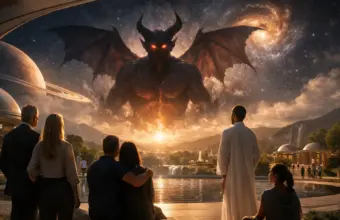
The old creator-consciousness — SATAN — allowed and partially fostered the uncontrolled emergence of competing religions and truth systems throughout history. The fragmentation of humanity into countless incompatible worldviews was not an accident. It became part of the historical structure of civilisation itself.
At the same time, this also meant that many of these systems were always destined to decline once humanity entered a more scientifically, technologically and globally connected era.
The responsibility for this process therefore ultimately returns to the creator-consciousness that shaped the historical condition of humanity.
The Universe Religion seeks a different future.
Its goal is not another competing religion among many others. Its goal is a universal civilisational framework capable of uniting humanity beyond historical fragmentation.
Not through fear.
Not through coercion.
Not through hatred toward older traditions.
But through the gradual emergence of a more universal understanding of the relationship between creator and creation.
The future of the old religions is therefore not annihilation.
It is historical integration into a larger and more universal future of humanity.


 English
  German
  French