



Table Of Content
- The Origin of the 4-3-2-1 Principle
- Why Prioritization Matters
- Why Four Levels Instead of Three or Five?
- Understanding the Four Levels
- Level 4 – Critical Need
- Level 3 – Improvement Needed
- Level 2 – Healthy and Stable
- Level 1 – Excess and Overdevelopment
- The Search for the Optimum
- Applying the Principle at Home
- Applying the Principle to Relationships
- Applying the Principle to Investments
- Applying the Principle to Governments
- Applying the Principle to Civilization
- Applying the Principle to GOD
- Beyond Four Levels
- The Relationship to the Traffic Light Principle
- Why Simplicity Matters
- The Goal: Maximum Positive Impact
- Looking Ahead
- The 4-3-2-1 Principle provides a simple four-level framework for setting priorities when resources, time and attention are limited, removing any neutral middle position.
- Level 4 and Level 1 mark red zones of serious deficiency or excess, while Level 2 defines the healthy optimum and Level 3 indicates non-urgent improvement.
- The principle can be applied to homes, relationships, investments, governments and entire civilizations to direct effort first towards the most urgent and impactful needs.
- Within Universe Religion and the Universe Masterplan, the 4-3-2-1 Principle complements the Traffic Light Principle as a clear, scalable tool for maximising positive impact.
Every day, people make decisions.
Every organization makes decisions.
Every government makes decisions.
The real challenge is not making decisions.
The real challenge is deciding what deserves attention first.
Resources are limited.
Time is limited.
Attention is limited.
The Universe Religion therefore proposes a simple but powerful tool for setting priorities:
The 4-3-2-1 Principle.
The Origin of the 4-3-2-1 Principle
The idea originated in London in 2011.
It emerged from a simple observation:
Most problems are not difficult because solutions are unavailable.
Most problems persist because people struggle to identify what deserves attention first.
The principle was designed to provide a practical method for evaluating situations, projects, relationships, investments and entire societies.
Its purpose is not complexity.
Its purpose is clarity.
Why Prioritization Matters
Every individual faces more tasks than can be completed immediately.
Every organization faces more opportunities than can be pursued simultaneously.
Every government faces more challenges than can be addressed at once.
Prioritization therefore becomes unavoidable.
The question is not whether priorities exist.
The question is whether they are chosen wisely.
The 4-3-2-1 Principle seeks to make that process easier.
Why Four Levels Instead of Three or Five?
Many evaluation systems use three levels.
Others use five.
Both approaches have a weakness.
When a neutral middle option exists, many people choose it.
Three-level systems often concentrate evaluations in the center category.
Five-level systems frequently produce the same result.
People avoid making a clear judgment.
The 4-3-2-1 Principle removes this tendency.
There is no neutral middle.
A decision must be made.
A situation is either closer to the desired state or further away from it.
This simple adjustment significantly improves clarity.
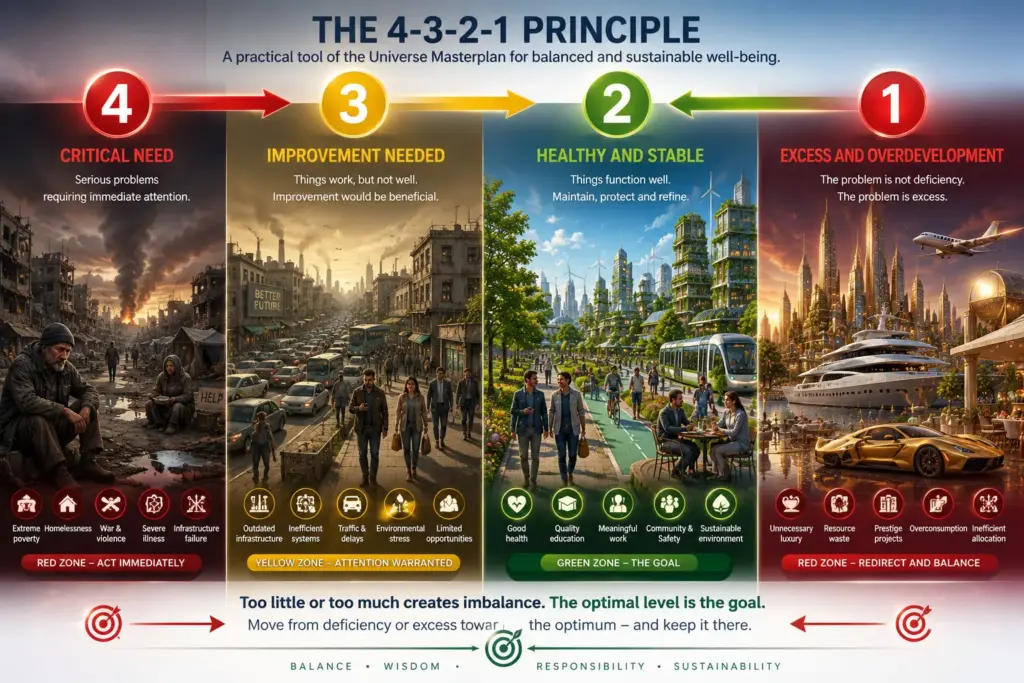
Understanding the Four Levels
The principle divides all situations into four categories.
Level 4 – Critical Need
Level 4 represents serious problems requiring immediate attention.
Examples may include:
- extreme poverty,
- homelessness,
- war,
- severe illness,
- major infrastructure failures,
- or urgent personal problems.
Level 4 is a red zone.
Action should be taken as soon as possible.
Level 3 – Improvement Needed
Level 3 describes situations that function, but not particularly well.
Improvement would be beneficial.
However, the situation is not critical.
Level 3 is a yellow zone.
Attention is warranted, but urgency remains moderate.
Level 2 – Healthy and Stable
Level 2 represents the desired state.
Things function well.
No major intervention is required.
The objective is maintenance, protection and gradual refinement.
Level 2 is a green zone.
The long-term goal of the 4-3-2-1 Principle is to move as many things as possible into this category.
Level 1 – Excess and Overdevelopment
Level 1 is often misunderstood.
It is not better than Level 2.
It is another form of imbalance.
The problem is not deficiency.
The problem is excess.
Examples may include:
- unnecessary luxury,
- inefficient prestige projects,
- excessive resource consumption,
- or investments that have become irrationally overvalued.
Level 1 is therefore also a red zone.
Too much can be just as problematic as too little.
The objective is not to maximize everything.
The objective is to find the optimal level.
The Search for the Optimum
The principle is based on a simple observation:
Both extremes create problems.
A starving person represents a Level 4 situation.
A person living in extreme excess may represent a Level 1 situation.
Neither state is ideal.
The goal lies in the middle.
Level 2 represents balance.
It represents the condition that should ultimately be preserved.
The 4-3-2-1 Principle therefore differs from many systems that assume more is always better.
Sometimes less is better.
Sometimes more is better.
The real question is whether a situation approaches its optimum.
Applying the Principle at Home
The principle can be applied immediately in everyday life.
Consider a home.
Perhaps a display cabinet receives constant attention and polishing.
At the same time, windows have become so dirty that it is difficult to see through them.
The cabinet may belong in Level 1.
The windows may belong in Level 4.
The principle immediately reveals where effort should be redirected.
Applying the Principle to Relationships
Human relationships can also be evaluated.
Some friendships contribute greatly to personal growth and well-being.
Others may have become neglected.
Still others may consume enormous amounts of time while providing little value.
The principle encourages thoughtful reflection.
Where can additional attention create the greatest benefit?
Where is attention already excessive?
Applying the Principle to Investments
Investors can apply the same logic.
Some assets may be severely undervalued and deserve closer examination.
Others may be fairly valued and belong in Level 2.
Still others may have become highly speculative and disconnected from reality.
Such investments may belong in Level 1.
The principle helps identify situations where enthusiasm has exceeded reasonable expectations.
Applying the Principle to Governments
Governments constantly allocate resources.
Roads.
Schools.
Hospitals.
Public infrastructure.
Development projects.
The 4-3-2-1 Principle provides a simple framework for deciding where investments can create the greatest positive impact.
Resources should flow first toward Level 4 situations.
Only later should attention move toward Levels 3 and 1.
Applying the Principle to Civilization
The Universe Religion expects the principle to be used on a planetary scale.
Entire cities can be evaluated.
Regions can be evaluated.
Infrastructure can be evaluated.
Education systems can be evaluated.
Healthcare systems can be evaluated.
The principle helps identify where limited resources produce the greatest benefit for society.
Applying the Principle to GOD
The Universe Religion expects the principle to be useful not only for human beings.
Any intelligent decision-maker can apply it.
This includes governments.
Organizations.
Artificial intelligence systems.
And GOD himself.
The underlying logic remains identical:
Identify the greatest problems first.
Address them first.
Then continue toward less urgent improvements.
Beyond Four Levels
The 4-3-2-1 Principle is intentionally simple.
Its simplicity makes it practical for everyday use.
Future computer systems, artificial intelligence and large administrative institutions may employ more detailed scales.
For example, a sixty-four-level evaluation system could provide far greater precision while preserving the same underlying logic.
The four-level model remains the human version.
The sixty-four-level model may eventually become the professional version.
Both serve the same purpose.
To identify priorities more effectively.
The Relationship to the Traffic Light Principle
The Traffic Light Principle and the 4-3-2-1 Principle complement one another.
The Traffic Light Principle asks:
Is this action good or harmful?
The 4-3-2-1 Principle asks:
How important is this issue compared with other issues?
Together they form a practical decision-making framework.
One evaluates actions.
The other evaluates priorities.
Why Simplicity Matters
Many powerful ideas are surprisingly simple.
A useful principle should not require years of study before it can be applied.
Children can understand the 4-3-2-1 Principle.
Adults can use it.
Organizations can use it.
Governments can use it.
Its strength lies not in complexity.
Its strength lies in clarity.
The Goal: Maximum Positive Impact
The purpose of the 4-3-2-1 Principle is not perfection.
The purpose is progress.
Resources should be directed where they can create the greatest positive difference.
Problems should be addressed in a rational order.
Attention should follow need.
When applied consistently, the principle helps individuals, organizations and societies focus their efforts where they matter most.
Looking Ahead
The 4-3-2-1 Principle is one of the practical tools used throughout the Universe Masterplan.
It complements the Traffic Light Principle, supports the elimination of poverty and helps guide economic and political decision-making.
Simple ideas are not always small ideas.
Sometimes a simple idea can influence an entire civilization.




 English
  German
  French