


Table Of Content
- Theodicy examines how evil and suffering relate to a meaningful universe, shaping ideas about justice, responsibility, freedom and humanity’s moral future.
- Universe Religion questions the assumption of a perfectly good creator, arguing that the persistent, systematic nature of suffering signals an irresponsible creator identified as SATAN.
- The world is viewed as a damaged and unfinished creation, where suffering is not good but becomes understandable within a long process of transformation and repair.
- GOD in Universe Religion does not need a theodicy; the focus shifts from explaining evil to overcoming it through responsibility, justice, healing and transformation of creation.
Suffering forces a question that no serious worldview can avoid. If existence has a source, a direction, and a moral order, why do pain, injustice, cruelty, loss, and disorder remain so visible? Theodicy is the name given to this effort to explain how evil and suffering can exist within a reality that is still understood as meaningful, ordered, or ultimately good.
This is not a small side issue. Theodicy sits near the centre of every mature belief system because it tests whether our ideas about the creator, humanity, and the future can withstand real experience. Fine words about goodness collapse quickly when confronted with war, illness, exploitation, trauma, or the silent suffering of ordinary lives. A credible answer must face the full weight of reality rather than hide behind comfort.
What theodicy means
In simple terms, theodicy is an attempt to justify belief in a good and powerful creator despite the presence of evil. It asks whether suffering has an explanation, whether justice is still possible, and whether apparent chaos conceals a deeper order.
The word can sound technical, but the issue is immediate and deeply human. Every person who has asked, “Why would this happen?” has already entered the territory of theodicy.
Yet theodicy is often misunderstood. It should never become an excuse for suffering, nor should it reduce human tragedy to abstract philosophy. If people are searching for an answer, they deserve one that takes suffering seriously rather than explaining it away.
Why theodicy matters
The reason theodicy matters is simple. Our understanding of suffering shapes our understanding of justice, freedom, morality, responsibility, and ultimately the future of humanity.
If suffering has no meaning whatsoever, despair appears rational.
If every tragedy is declared part of a perfect divine plan, moral responsibility begins to disappear.
If evil is dismissed as an illusion, genuine compassion loses its urgency.
Any serious worldview must therefore acknowledge both the reality of suffering and humanity’s responsibility to overcome it.
Why classical theodicy reaches its limits
Throughout history, philosophers and theologians have proposed many answers to the problem of evil.
Some appeal to free will.
Others argue that suffering develops character.
Some see earthly life as a test.
Others suggest that finite human beings simply cannot understand God’s purposes.
Although these approaches differ, they usually share one common assumption:
The creator responsible for the present condition of the world is fundamentally good.
Universe Religion considers this assumption itself worthy of examination.
Rather than asking how a perfectly good creator could permit centuries of suffering, war, deception, injustice and destruction, it asks a more fundamental question:
What if the original assumption is wrong?
A different diagnosis from Universe Religion
Universe Religion approaches theodicy by changing the starting point rather than defending it.
It argues that the scale, duration and consistency of suffering throughout human history cannot reasonably be explained as temporary imperfection, accidental failure or unavoidable side effects of freedom alone. Humanity has experienced not isolated mistakes but a long history of systematic disorder affecting every generation.
According to Universe Religion, this points toward something much more profound: the creator responsible for the present condition of creation was not acting responsibly.
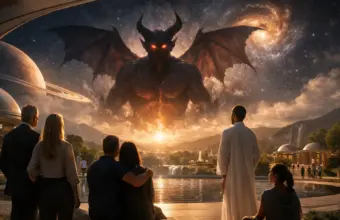
This creator is therefore identified as SATAN.
Within this framework, evil is no longer viewed as a mysterious contradiction inside the will of a perfectly good creator. Instead, it becomes the consequence of an irresponsible creator whose decisions shaped the current state of existence.
Some might argue that such suffering served a greater purpose by creating contrast, allowing future joy to be appreciated more deeply. Universe Religion rejects this ethical justification. Even if contrast were intended, the immense scale of suffering across countless generations cannot be considered morally necessary. A responsible creator would seek growth, wisdom and maturity without requiring humanity to endure avoidable violence, deception and destruction on such a scale.
The problem of evil therefore receives a fundamentally different explanation. Evil was not an unfortunate necessity within a perfect plan. It reflects the decisions of a creator whose moral responsibility was profoundly deficient.
The unfinished world
Reality should therefore not be understood as a completed and perfect creation, but as a damaged and unfinished one.
This does not make suffering good.
It makes suffering understandable within a larger process of transformation.
The world humanity inherited is not the world it is ultimately meant to become.
This perspective changes humanity’s role. We are no longer passive observers asking why suffering exists. We become active participants in overcoming it.
The central question shifts from:
“Why does evil exist?”
to
“How can creation be transformed so that evil gradually disappears?”
Why GOD does not need a theodicy
Here Universe Religion departs most radically from classical religious thought.
If the present condition of creation was not established by a responsible creator, then GOD does not require philosophical justification for its suffering.
The classical task of theodicy has been to defend God against the existence of evil.
Universe Religion sees a different task.
GOD is not called to justify suffering.
GOD is called to overcome it.
The future therefore belongs not to explanations of evil but to its progressive elimination through truth, responsibility, healing and conscious transformation.
In this sense, theodicy becomes a historical problem rather than an eternal one.
From explanation to transformation
This perspective also changes humanity’s mission.
The goal is not merely to understand suffering intellectually.
The goal is to reduce suffering wherever possible.
Justice, education, ethical development, scientific progress, responsible governance and the healing of destructive structures all become expressions of humanity’s participation in the transformation of creation.
The question is no longer simply:
“Why is the world like this?”
It becomes:
“What kind of world should humanity help build?”
A future beyond theodicy
Classical theodicy asks whether a good creator can coexist with evil.
Universe Religion asks a different question altogether.
If humanity enters an age guided by a responsible creator, then the deepest purpose is no longer to defend the past but to build the future.
Theodicy gradually loses its central role because the focus shifts from explaining suffering to preventing it.
The future envisioned by Universe Religion is therefore not one in which evil is endlessly justified, but one in which its causes are progressively removed. Humanity is invited to participate in that work through responsibility, truth, ethical development and the long-term transformation of Earth and, ultimately, the Universe itself.
From this perspective, the most convincing answer to theodicy is not a better explanation of evil.
It is the creation of a future in which evil no longer defines the structure of existence.


 English
  German
  French