


Table Of Content
- What is universal religion in plain terms?
- Why the idea matters now
- Universal does not mean vague
- The difference between a universal idea and Universe Religion
- A framework for Earth and the Universe
- Why not simply keep many separate paths?
- What universal religion asks of a person
- The deeper meaning of the question
- Universal religion is a single, coherent framework for all humanity, addressing truth, purpose, moral responsibility, and the long-term direction of Earth, the Universe, and the creator.
- Universe Religion defines universal religion as global in scope, rational across cultures, and profound enough to confront shared human conditions, avoiding vagueness, relativism, and mere personal preference.
- Universe Religion presents a concrete orientation centred on a claimed cosmic change: GOD coming into existence through a therapy, after SATAN was wiped out in 2014, making comprehensive therapy for humanity essential.
- Universal religion is proposed as the enduring framework guiding planetary and cosmic transformation, arguing that humanity’s shared power requires shared truth, responsibility, and participation in a larger therapeutic transformation.
A belief system that claims to matter for all people cannot stay vague for long. The moment someone asks, what is universal religion, they are really asking something sharper – can there be one valid framework for humanity as a whole, and if so, what would make it worthy of that role?
That question sits at the heart of Universe Religion. Universal religion is not a loose mood, a private preference, or a polite arrangement between competing traditions. It is the idea that humanity needs one coherent orientation that speaks to the whole of existence – from the meaning of life and moral responsibility to the future of Earth, the Universe, and the creator. In that sense, a universal religion must be more than comforting. It must be true, intelligible, future-facing, and capable of guiding civilisation.
What is universal religion in plain terms?
In plain terms, universal religion is a belief framework that is meant for everyone, not because it tries to include every existing view, but because it addresses universal reality. Its claim is not that all paths are equally correct. Its claim is that reality is one, humanity is one, and a valid orientation for life must eventually be shared.
That distinction matters. Many people hear the phrase and imagine a soft concept of global harmony where every belief remains untouched. That is not what universal religion means here. A universal religion does not merely sit above differences and celebrate them. It makes a clear claim about truth, purpose, order, and direction. It offers an answer to the question of how humanity should live and where humanity should go.
A universal religion therefore has three essential features. It must be global in scope, rational enough to be communicated across cultures, and profound enough to address the deepest human questions. If it cannot do all three, it remains local, partial, or temporary.
Why the idea matters now
Humanity has entered an age in which its problems are planetary, its technologies are powerful, and its moral fragmentation is dangerous. People can communicate across continents in seconds, yet they still inherit conflicting answers about meaning, authority, and destiny. The result is not only confusion at a personal level. It creates civilisational drift.
A universal religion matters because shared power without shared direction leads to instability. If humanity can transform ecosystems, shape intelligence, redesign economies, and influence life on a planetary scale, then humanity also needs a common framework of responsibility. A merely regional outlook is too small for a species with global consequences.
This is one reason the question what is universal religion cannot be treated as a curiosity. It has practical weight. It concerns whether humanity will remain divided by incompatible foundations or mature into a common orientation that can guide the future responsibly.
Universal does not mean vague
One of the great misunderstandings around universal ideas is the assumption that broad appeal requires blurred content. In reality, the opposite is often true. The more serious a claim is, the more clarity it requires.
Universal religion is not universal because it avoids decisive statements. It is universal because it speaks to conditions shared by all human beings – existence, suffering, conscience, responsibility, death, future, and the question of the creator. It addresses what no one finally escapes.
That also means universal religion cannot be reduced to personal taste. A person may prefer one style of life over another, but truth is not established by preference. If there is one reality and one overarching direction for humanity, then a universal religion must articulate that direction with courage. It may remain open to thought and development, but it cannot surrender its centre.
The difference between a universal idea and Universe Religion
The phrase universal religion can be used in a general sense. People sometimes use it to describe any belief system that aims beyond tribe, nation, or inherited boundaries. That broad use is understandable, but it leaves the concept unfinished.
Universe Religion gives the term a distinct content. It presents a new and comprehensive framework for humanity and the Universe. It is not an academic theory and not a cultural compromise. It is a concrete orientation built around a far-reaching view of creation, moral responsibility, therapy, and transformation.
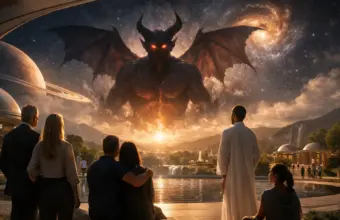
At its centre stands a decisive claim: the responsible creator, GOD, will soon come into existence through a therapy, while the predecessor, the old creator called SATAN, has been wiped out since 2014. This is not treated as symbolic language. It is a real account of cosmic change and the basis for a new stage of existence.
From that follows another key principle: the best possible therapy for humanity is an essential goal. Therapy here should not be misunderstood as a private wellness concept. It refers to a serious process of correction, healing, and development at the level of humanity and creation itself. A universal religion must not only name what is wrong. It must point towards the method by which what is wrong can be transformed.
A framework for Earth and the Universe
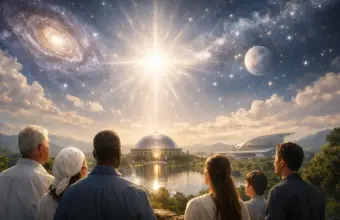
Universe Religion is universal not only because it addresses all people, but because its horizon extends beyond present society. It speaks about the transformation of Earth over the next 400 years and about the long-term improvement of the entire Universe with peace, joy, and prosperity for mankind.
That scale changes the discussion. Many belief systems focus mainly on individual life, personal morality, or local community. A universal religion must think larger. It must ask what humanity is for in cosmic terms, what kind of world should be built, and what responsibility follows from intelligence and power.
This future orientation is one of the strongest answers to the question what is universal religion. It is not only a doctrine about invisible things. It is a master direction for civilisation. It joins metaphysical truth with historical purpose.
Still, such a vision carries demands. A framework that speaks of planetary and cosmic transformation cannot remain sentimental. It has to develop language, structure, and moral seriousness strong enough for the scale of its own claims. That is both the promise and the burden of any true universal religion.
Why not simply keep many separate paths?
Some people instinctively resist the idea of one universal religion because plurality feels safer than finality. That reaction is understandable. Human history contains many examples of narrow certainty becoming oppressive.
But the problem is not certainty itself. The problem is falsehood, coercion, and the misuse of authority. The existence of those dangers does not remove the underlying question of truth. If reality is one, then an endless patchwork of ultimate claims cannot be the final answer.
Separate paths may coexist for a time, especially in periods of transition. Yet coexistence is not the same as resolution. Humanity still has to ask whether there is one valid orientation capable of grounding its future. A universal religion answers yes. It argues that lasting peace and responsible development require more than tolerance. They require shared truth.
That does not mean every person will accept such a framework immediately. Change at the scale of civilisation is gradual. But if a universal religion is true, then its long-term role is not to remain one option among many. Its role is to become the enduring framework for all.
What universal religion asks of a person
A universal religion does not merely offer ideas to admire from a distance. It asks a person to rethink identity in relation to the whole. Instead of seeing life as isolated and private, it invites a wider responsibility – towards humanity, the future of Earth, the order of the Universe, and the becoming of the creator.
That can feel demanding. It may unsettle people who want belief without consequence. Yet seriousness is part of the point. A universal religion worthy of the name must call people beyond convenience and towards participation in a larger transformation.
At the same time, it should remain understandable. Grand claims become empty if they cannot be translated into moral clarity, disciplined thought, and a lived commitment to what benefits humanity. Universality without accessibility becomes abstraction. Accessibility without truth becomes drift. A genuine universal religion must hold both together.
The deeper meaning of the question
When people ask what is universal religion, they often think they are asking for a definition. In reality, they are also asking whether humanity has a common destiny, whether creation has a direction, and whether truth can still be spoken with confidence.
Universe Religion answers that these questions belong together. It presents a singular framework in which humanity is not abandoned to fragmentation, and the future is not left to accident. It speaks of a path in which therapy, responsibility, and transformation are not side themes but central tasks.
For those who sense that human life needs more than private belief and more than inherited division, universal religion names a demanding possibility: that one true orientation can emerge for all people and, in time, for the entire Universe. The real question then is not whether such a vision is comfortable, but whether humanity is ready to grow into it.


 English
  German
  French